task:
New construction of a multi-storey residential building in timber construction with 186 flats and underground car park
client:
Project development LP 1-4: Implenia Marienplatz Hochhaus GmbH, Raunheim
Implementation LP 5-8: Implenia Hochbau GmbH, Major Projects Division, Raunheim
verfahrensart:
Concept award following the Marienplatz 2019 urban development competition, 1st prize
size:
approx. 22,000 sqm above-ground gross floor area R+S
completion:
planned 2029
technical planner:
Fast + Epp GmbH (structural engineering) | SGS Engineering GmbH (acoustics/ thermal building physics) | IGP Ingenieure (building services engineering)/electrical) | HTA Sachverständigenbüro (fire protection) | GTL Landschaftsarchitektur Part mbB (landscapearchitects) | Arcadis Germany GmbH (ground surveyor | Hess Timber GmbH (Consulting on timber construction) | DGNB (sustainability certification)
team:
Isabelle Pertack (pl LP1-4), Kathrein Hildebrandt (pl LP5), Moritz Bayer, Eva Birnstiel, Mariana Georgieva, Tim Heidland, Kathrein Hildebrandt, Hannah Jacobs, Isabelle Pertack, Andrea Weber Alexander Grams (freie MA), Ann-Catrin Schleifer (freie MA), Toka Mohamed (stud.), Jan Tovar (stud.)
visualizations:
luxfeld digital art, Darmstadt
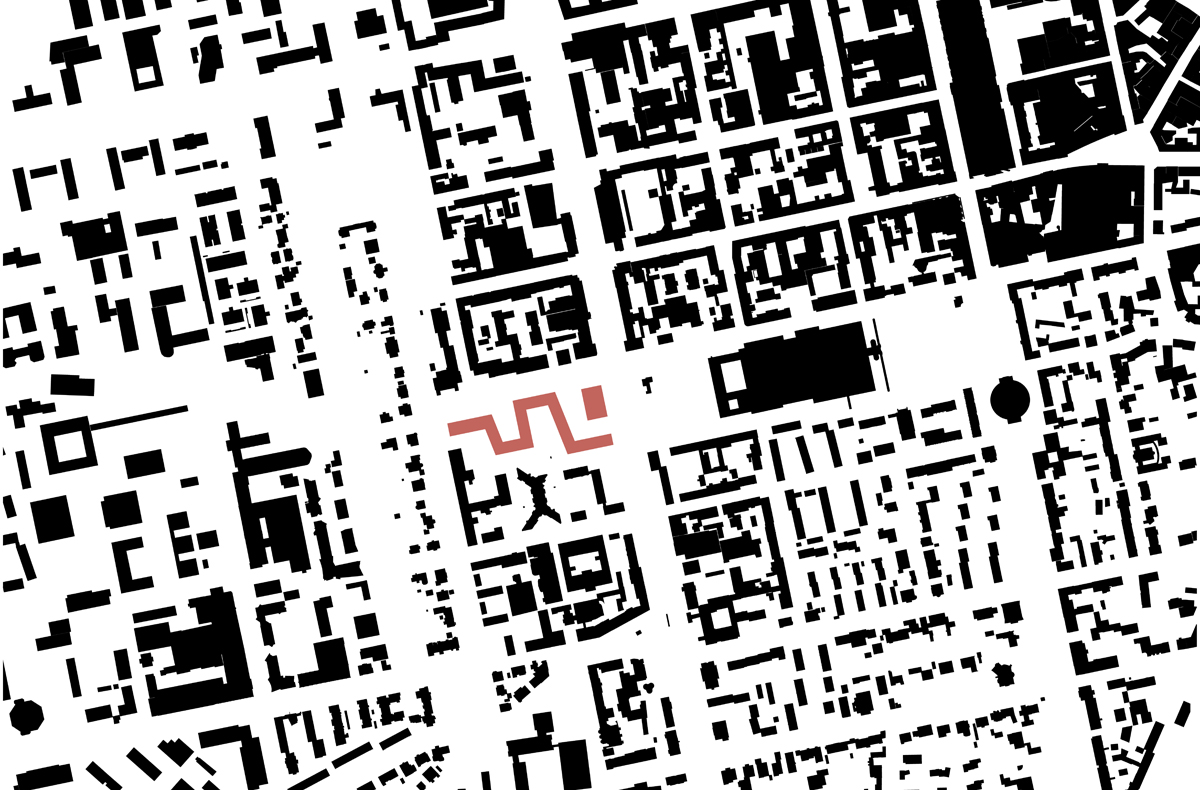
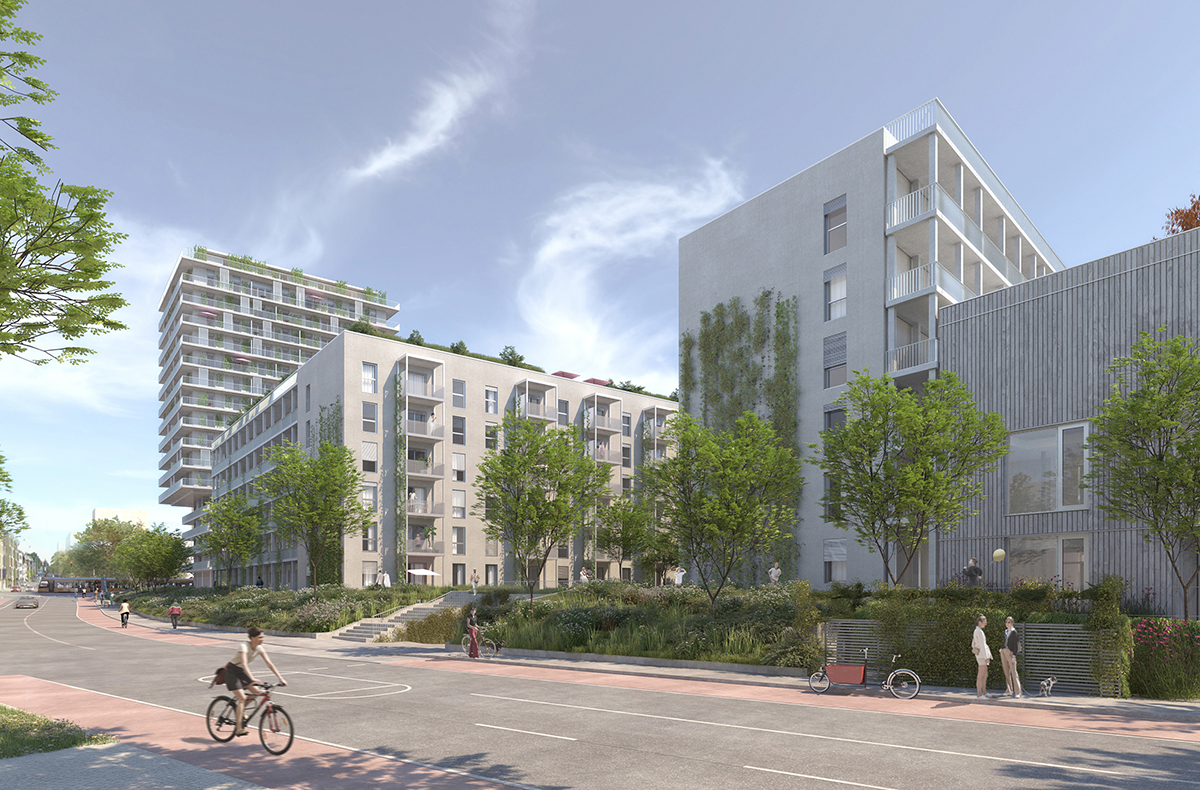
The central complex “Marienplatz Darmstadt” connects Darmstadt city centre with the so-called publishing district and the campus of Darmstadt University of Applied Sciences. On the city side, this important east-west connection begins at its highest point with the residential high-rise, from which a promenade leads westwards along the meandering development (multi-storey residential building) and the adjacent daycare centre to Fritz-Bauer-Straße.
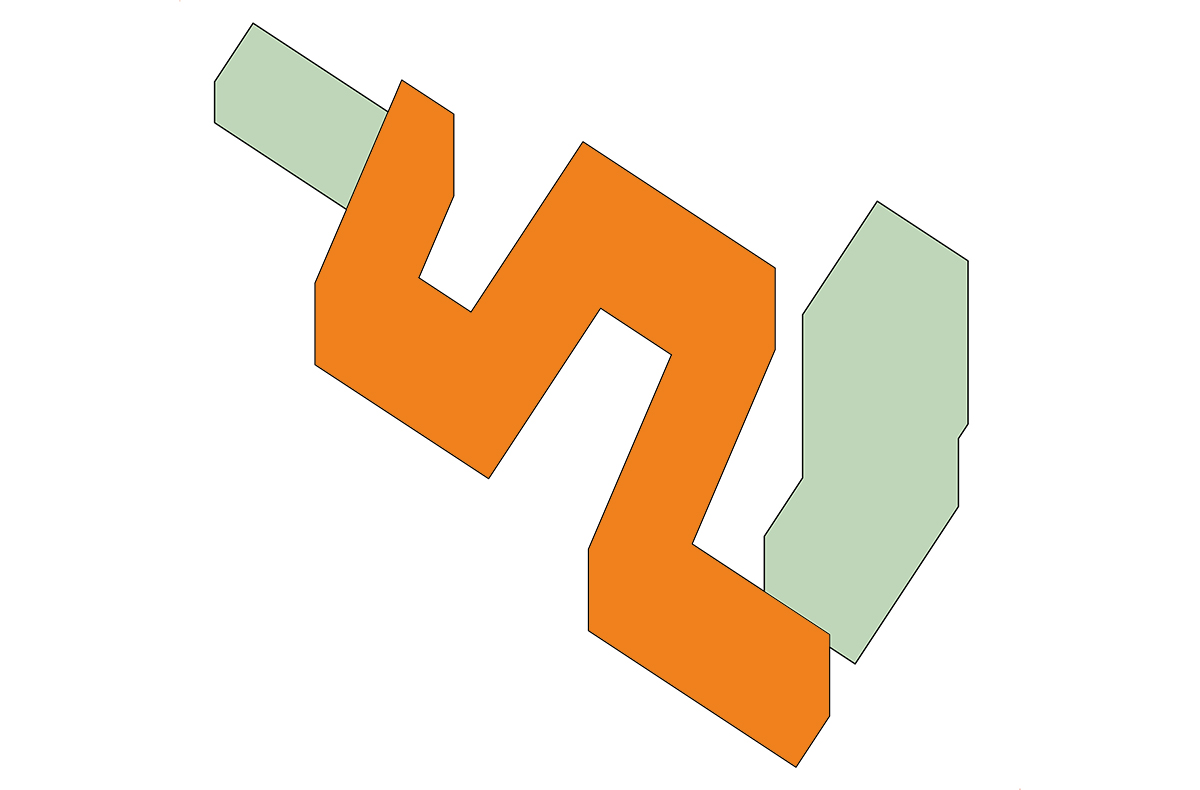
The urban ensemble is being developed by three builders on three separate plots: high-rise (Implenia Marienplatz Hochhaus GmbH), Mäander (Implenia II. Marienplatz Mäander GmbH) and daycare centre (City of Darmstadt).
The outdoor areas of the residential development are zoned by the shape of the buildings. The open spaces of the Mäander and high-rise buildings merge into one another; they are not fenced off, but are accessible to the public throughout.
The communal roof gardens of the Mäander and the base of the high-rise building are at a similar height and form a second open space level. The Mäander and high-rise buildings are also connected by a shared basement and underground car park.
In the west, the daycare centre continues the meandering structure. However, it is structurally and functionally independent.
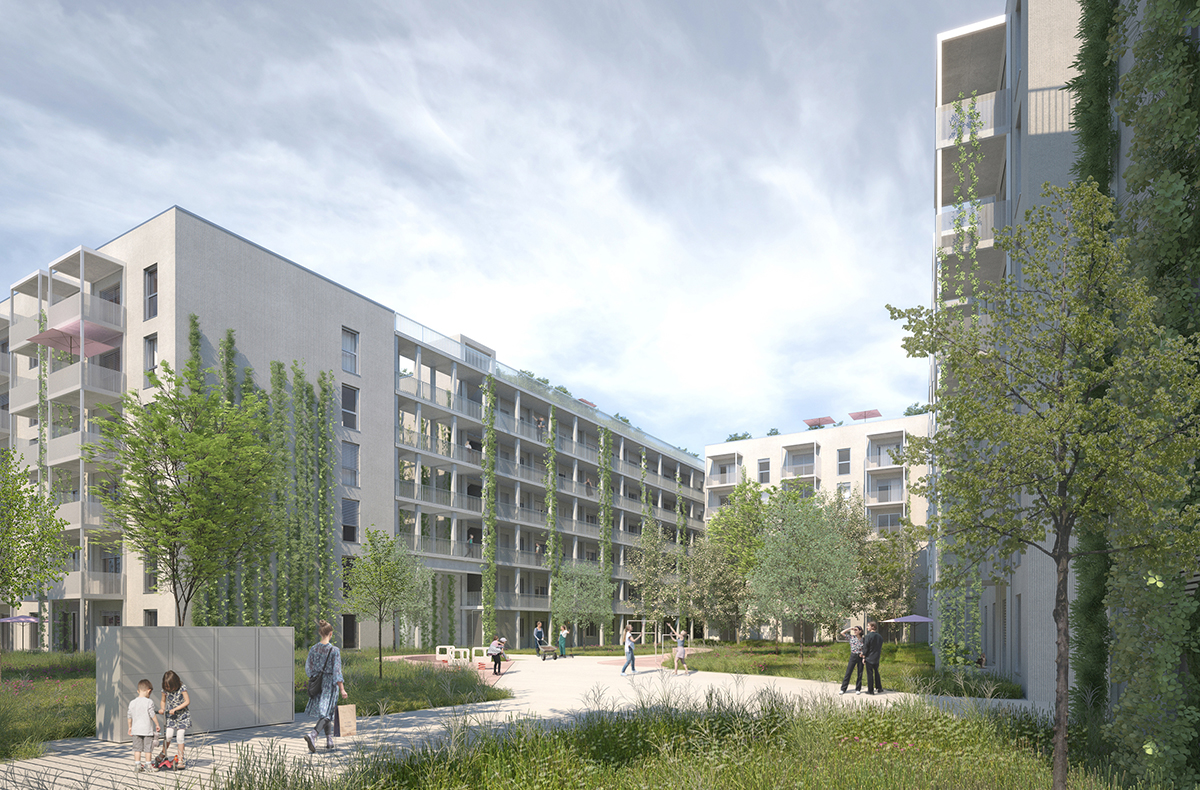
The “meander” encompasses Marienplatz in a building structure that is highly dense, compact and striking. The division of the building volume into six identifiable sections creates three courtyards that open alternately to the north and south. The courtyards are connected to each other via passageways.
All sections of the six-storey residential building, constructed in timber, are connected by a shared pergola made of precast reinforced concrete elements.
The Mäander comprises 186 flats (two to five rooms), most of which are being built as subsidised housing for low and middle incomes. Subsidised and privately financed flats are mixed in their arrangement and have the same floor plans.
The neighbourhood is characterised by a high degree of greening – in the open spaces, on roofs and roof gardens, on facades and pergolas.
The energy concept is based on the use of district heating, which is distributed via the floor surfaces.
Photovoltaics on the roof surfaces supply electricity for the operation of building services and consumption in common areas. Surplus electricity is fed into the grid.
The planning and implementation of the “Mäander” are being supervised by the DGNB. The aim is to achieve “Gold” standard certification.
The central complex “Marienplatz Darmstadt” connects Darmstadt city centre with the so-called publishing district and the campus of Darmstadt University of Applied Sciences. On the city side, this important east-west connection begins at its highest point with the residential high-rise, from which a promenade leads westwards along the meandering development (multi-storey residential building) and the adjacent daycare centre to Fritz-Bauer-Straße.
The urban ensemble is being developed by three builders on three separate plots: high-rise (Implenia Marienplatz Hochhaus GmbH), Mäander (Implenia II. Marienplatz Mäander GmbH) and daycare centre (City of Darmstadt).
The outdoor areas of the residential development are zoned by the shape of the buildings. The open spaces of the Mäander and high-rise buildings merge into one another; they are not fenced off, but are accessible to the public throughout.
The communal roof gardens of the Mäander and the base of the high-rise building are at a similar height and form a second open space level. The Mäander and high-rise buildings are also connected by a shared basement and underground car park.
In the west, the daycare centre continues the meandering structure. However, it is structurally and functionally independent.
The “meander” encompasses Marienplatz in a building structure that is highly dense, compact and striking. The division of the building volume into six identifiable sections creates three courtyards that open alternately to the north and south. The courtyards are connected to each other via passageways.
All sections of the six-storey residential building, constructed in timber, are connected by a shared pergola made of precast reinforced concrete elements.
The Mäander comprises 186 flats (two to five rooms), most of which are being built as subsidised housing for low and middle incomes. Subsidised and privately financed flats are mixed in their arrangement and have the same floor plans.
The neighbourhood is characterised by a high degree of greening – in the open spaces, on roofs and roof gardens, on facades and pergolas.
The energy concept is based on the use of district heating, which is distributed via the floor surfaces.
Photovoltaics on the roof surfaces supply electricity for the operation of building services and consumption in common areas. Surplus electricity is fed into the grid.
The planning and implementation of the “Mäander” are being supervised by the DGNB. The aim is to achieve “Gold” standard certification.